Introduction: The New Era of Farmer Welfare in Telangana
The agricultural landscape of Telangana is undergoing a profound structural transformation. As the backbone of the state’s economy, agriculture supports nearly 45.8% of the population, yet it has historically been plagued by cycles of debt and volatile input costs. To address these systemic vulnerabilities, the Congress government has established the Rythu Bharosa scheme as a definitive cornerstone of its “Six Guarantees.”
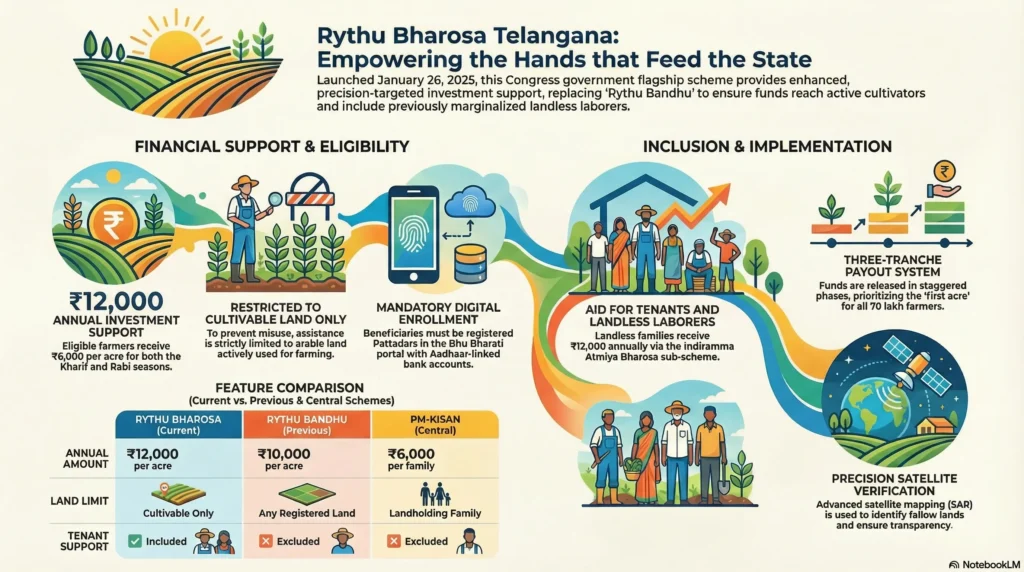
Rythu Bharosa is more than a simple financial subsidy; it is a strategic intervention designed to restore dignity to the farming community and break the “toxic combination” of escalating input costs and exploitative informal credit. Historically, marginal farmers have been trapped in debt cycles with interest rates ranging from 24% to 36% annually. The core philosophy of this program is to provide upfront capital, ensuring that agriculture becomes a sustainable livelihood rather than a source of distress. Officially launched on January 26, 2025, the scheme serves as the primary engine driving the “Telangana Rising” agenda, moving beyond reactive measures toward proactive investment support.
Rythu Bharosa vs. Rythu Bandhu: What has Changed?
The transition from the previous administration’s “Rythu Bandhu” to the current “Rythu Bharosa” represents a shift toward higher financial support, tighter administrative oversight, and a commitment to fiscal discipline. While the previous regime provided India’s first large-scale investment support, it was marred by what policy analysts describe as “gross financial indiscipline.”
The Strategic Shift in Funding and Oversight
The most immediate change is the increase in financial assistance. Under Rythu Bandhu, farmers received ₹10,000 per acre annually. Rythu Bharosa has enhanced this to ₹12,000 per acre annually, split into two installments of ₹6,000 for the Kharif and Rabi seasons.
Beyond the amount, the government has introduced a strict “cultivable land only” policy. Under the previous regime, preliminary estimates suggest a staggering ₹22,606 crore was disbursed to lands not under cultivation. This included hillocks, roads, industrial zones, and real estate ventures. In Rangareddy district alone, joint surveys revealed that misuse cost the state ₹312 crore over six years, where benefits were extended to petrol pumps, resorts, and villas. In ten specific mandals of Rangareddy, a shocking 90% of beneficiaries were found ineligible under the new criteria.
By focusing exclusively on active cultivators, Rythu Bharosa ensures that public funds are not wasted on speculators but are channeled to those actually working the soil.
Competitor Comparison Table
| Feature | Rythu Bharosa (Current) | Rythu Bandhu (Previous) | PM-KISAN (Central) |
| Annual Amount | ₹12,000 per acre | ₹10,000 per acre | ₹6,000 per family |
| Installment Structure | 2 Seasons (₹6,000 each) | 2 Seasons (₹5,000 each) | 3 Intervals (₹2,000 each) |
| Land Eligibility | Cultivable Arable Land Only | All Registered Land | Landholding Families |
| Support for Tenants | Included (Indiramma Atmiya Bharosa) | Strictly Excluded | Excluded |
| Budget Impact | 51-66% of Ag-Budget | Approx. 50% | Central Funding |
Comprehensive Eligibility Criteria for 2026
To qualify for Rythu Bharosa in the 2026 cycle, applicants must meet rigorous residency and land-use requirements. This ensures that public funds are utilized specifically for agricultural production rather than real estate speculation.
Who is Eligible?
- Permanent Residents: Applicants must be permanent residents of Telangana.
- Small and Marginal Farmers: The scheme prioritizes those engaged in active cultivation. Small and marginal farmers (SMFs) constitute 72% of the beneficiary base.
- Pattadars: Individuals with valid land titles registered in the revenue records.
- ROFR Holders: Tribal farmers possessing Recognition of Forest Rights (ROFR) titles.
- Registration Requirements: All land must be updated and verified on the Bhu Bharati portal (the revamped revenue system replacing Dharani).
Strict Exclusion Rules
The “red thread” of the new policy is the exclusion of any land not actively used for agriculture. Based on joint field surveys in high-conversion zones like Patancheru and Kandi mandals in Sangareddy district, the following categories are strictly ineligible:
- Real estate layouts, ventures, and villas.
- Mining lands, stone crushers, and industrial zones.
- Institutional lands occupied by warehouses or function halls.
- Infrastructure such as roads (e.g., Rajiv Rahadari), canals, and government project sites.
- Fallow or non-cultivable plots identified through satellite and field verification.
Step-by-Step Guide: How to Apply for Rythu Bharosa
New applicants, particularly those who received their Pattadar passbooks after February 2026, must navigate a multi-stage application process designed for transparency.
Application Channels
- Offline: Completed forms can be submitted at local Gram Sabhas, Gram Panchayat offices, or Municipal Corporation offices.
- Online/Service Centres: Farmers can visit the nearest Praja Palana Centre or Common Service Centre (CSC) to upload their details digitally.
Required Documents Checklist
- Aadhaar Card: Primary identity for e-KYC.
- Pattadar Passbook (PPB): Proof of land ownership.
- Aadhaar-linked Bank Passbook: Required for Direct Benefit Transfer (DBT).
- Domicile Certificate: Proof of Telangana residency.
- Registered Lease Deed: Mandatory for tenant farmers seeking support.
The Verification Workflow (L1, L2, L3)
The government employs a triad verification system involving the Revenue, Agriculture, and Panchayat Raj departments:
- Stage L1 (Joint Survey): A field verification by the Agriculture Extension Officer (AEO) and Revenue Inspector to ensure the land is cultivable and not located in prohibited zones (like FTL water body buffers).
- Stage L2 (Technical Scrutiny): Town planning staff verify layout patterns and land classification against digitized maps to prevent real estate “leakage.”
- Stage L3 (Final Approval): The District Collector provides the final sanction after verifying Aadhaar-seeding and bank account validity.
The 2026 Payout Schedule: March & April Updates
The 2026 rollout is designed to address the 40-fold disparity between large and marginal farmers that existed under previous models. The disbursement is set to begin on March 22, 2026, with a flagship event in Narmetta village, Siddipet district.
The 3-Step “First-Acre Priority” Timeline
The government has adopted a staggered, technical adjustment to prioritize the most vulnerable:
- Phase 1 (March 22): The first tranche of ₹3,590 crore is released. Every one of the 70 lakh eligible farmers receives payment for their first acre (₹6,000) simultaneously. This ensures immediate liquidity for small and marginal farmers who need it most for initial inputs.
- Phase 2 (Mid-April): Approximately 20 days later, the second phase begins, covering the full entitlement for mid-sized holdings.
- Phase 3 (Late April): The final phase completes disbursement for large-scale landholders and any remaining acreage balances.
This method ensures fiscal stability for the state while providing an immediate “safety net” to the entire farming population at the start of the season.
Status Check: Tracking Your Payment and Application
Monitoring your application via rythubharosa.telangana.gov.in is the most effective way to ensure timely support.
The Role of DBT and Aadhaar Seeding
Payments are processed via the RBI’s Direct Benefit Transfer (DBT) system. This eliminated the 15-20% inclusion error seen in older manual systems. However, your bank account must be Aadhaar-seeded. If your e-KYC is incomplete, the payment will be stalled in the RBI pipeline.
Troubleshooting
- Wrongly Marked Land: If your cultivable land is marked as “non-agricultural,” you must visit the Bhu Bharati grievance cell.
- Missing Payments: If Phase 1 has passed and you haven’t received funds, verify your status online. Rejections are often due to “Technical Scrutiny” identifying the land as part of a real estate layout.
Additional Support: Loan Waivers and Social Safety Nets
Crop Loan Waiver
The government has cleared ₹20,616 crore in loans for 25.35 lakh farmers. This waiver applies to short-term agricultural loans taken between December 12, 2018, and December 9, 2023. Unlike previous regimes that only covered interest, this initiative targets the principal amount to truly unburden households.
Support for Landless Laborers: Indiramma Atmiya Bharosa
Landless laborers, who were systematically excluded from Rythu Bandhu, now receive ₹12,000 annually.
- Eligibility: Identified via MGNREGS data.
- Requirement: Minimum 20 days work in the 2023–24 financial year.
Fiscal Sustainability Concerns
As a Senior Policy Analyst, it is important to note that Rythu Bharosa consumes between 51% and 66% of the total agriculture budget. While this provides immediate relief, experts warn of a “crowding out” effect on other vital investments such as cold chains, agricultural R&D, and irrigation infrastructure modernization. The state is balancing this by tightening eligibility to ensure not a single rupee is wasted on non-arable land.
Technical Analysis: Sociological Impact and Macro Performance
The “Debt Trap” and Sociological Transformation
Scholarly evaluations (IJFMR, 2024) highlight that before such schemes, 92% of landholders were Small and Marginal Farmers facing a “vicious debt cycle.” Rythu Bharosa addresses this by injecting liquidity exactly when informal moneylenders traditionally exploit farmers. The proportion of “Low Income” farmers (below ₹60,000/year) has dropped by 64.3% since the inception of investment support in the region.
Equity Gaps and Yield Realities
A critical finding in recent audits shows that SMFs constitute 72% of beneficiaries but historically received only 50.1% of disbursements due to the per-acre model. The 2026 “first-acre” rollout is specifically designed to bridge this equity gap. Furthermore, while capital is now available, Telangana’s paddy yields (4,229 kg/ha) still lag behind global leaders like China (7,076 kg/ha). The 2026 vision focuses on moving farmers toward higher-quality seeds and better soil management.
Macroeconomic Indicators
The Agriculture Gross State Value Added (GSVA) in Telangana has tripled, growing from ₹41,707 crore in 2014 to ₹1,22,351 crore in 2023-24. The state’s agricultural CAGR of 12.7% continues to outperform the national average of 8.4%, proving the efficacy of direct investment.
Future Outlook: AI and Modernization
The “Telangana Rising 2047” vision integrates Rythu Bharosa with global technology. In partnership with Google, the state is deploying AI for:
- Soil Health Monitoring: Real-time analysis to optimize fertilizer use.
- Climate Resilience: Predictive modeling to combat erratic monsoons.
The CURE, PURE, RARE Framework
The state is adopting the CURE (Core Urban), PURE (Peri-Urban), and RARE (Rural Agriculture Region) framework. This ensures that farmers in Peri-Urban areas (like those near the GHMC limits in Sangareddy) are transitioned into high-value “Peri-Urban” agriculture or protected from illegal land conversion through the Bhu Bharati digital shield.
Conclusion & Action Steps for Farmers
The March 22, 2026 rollout is a milestone for 70 lakh families. To ensure success:
- Verify Bhu Bharati Status: Ensure your land is correctly marked as “cultivable.”
- Complete eKYC: Visit your bank to link Aadhaar for DBT.
- New Passbooks: If your passbook is post-February 2026, visit your local AEO for enrollment.
- Monitor the Portal: Track your application through the L1, L2, and L3 stages.
Frequently Asked Questions (FAQs)
Can I receive both PM-KISAN and Rythu Bharosa?
Yes. Eligible farmers can receive the ₹6,000 annual benefit from PM-KISAN plus the ₹12,000 per acre from the Telangana State Rythu Bharosa scheme.
What happens if my land is marked non-cultivable?
Non-cultivable land (real estate, mining, etc.) is ineligible. If this is an error, you must visit the Bhu Bharati grievance cell or the Tahsildar for a joint survey by the Revenue and Agriculture triad.
How do I update my mobile number for DBT?
Visit a Praja Palana centre or your local Tahsildar office. Aadhaar-linked mobile numbers are mandatory for payment alerts.
How many installments are there in 2026?
The ₹12,000 benefit is split into two seasonal installments of ₹6,000. The rollout begins March 22 with the “first-acre” priority phase.
Is the loan waiver separate from Rythu Bharosa?
Yes. The ₹2 lakh crop loan waiver is a separate, one-time debt relief initiative. Rythu Bharosa is an annual, recurring investment support program.