As a senior real estate consultant navigating Hyderabad’s explosive market—which has seen a 12% annual value increase with prices reaching an average of ₹6,000 per sq. ft. in 2025—I cannot overstate the importance of the Encumbrance Certificate (EC). In a high-stakes environment where over 400,000 ECs are issued annually, this document is your primary defense against title fraud and a critical “health certificate” for your investment.
An encumbrance signifies any legal or financial liability attached to a property, such as outstanding mortgages, liens, or legal claims. The EC provides the documented “chain of transactions” registered with the state, ensuring the property is free from hidden liabilities. In Telangana, these records are governed by the Registration and Stamps Department (IGRS) for urban and pre-2020 agricultural land, and the Bhu Bharathi Portal for agricultural land registered after 2020.
What Exactly is an Encumbrance Certificate in Telangana?
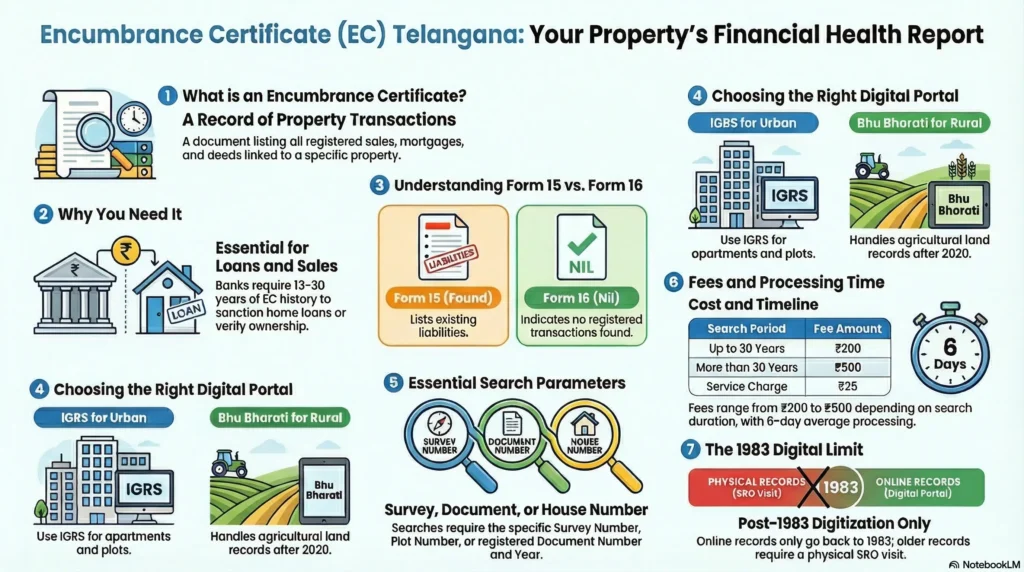
The EC is the cornerstone of legal verification. It is mandatory for property sales, securing home loans (where banks typically require a 10–15 year history), and serving as admissible evidence in judicial matters. To search effectively, you often need specific technical data including the SRO (Sub-Registrar Office) Code, the Registration Year, and occasionally the Volume/CD Number found on the original Sale Deed.
The “1983 Rule” and Manual Records
A common point of confusion for investors is the availability of data. Digital records in Telangana are only available from January 1st, 1983.
- Digital Era: If your transaction history falls after this date, you can use the online portals.
- Pre-Digital Era: Records dating back to the “inception of the Registration Department” exist, but they are manual. If you require a search for a period before 1983, a physical visit to the concerned SRO is mandatory to perform a manual ledger search.
Types of EC: Form 15 vs. Form 16
The result of your search will yield one of two specific government forms:
- Form 15: This is issued when transactions (sales, mortgages, gift deeds, or leases) are found on the property during the requested search period. It provides a chronological list of these acts.
- Form 16 (Nil EC): This is issued when no registered transactions are found for the property during the specified timeframe.
Why You Might Receive a “Nil EC”
A “Nil EC” does not always mean the property has a “clean” history; it simply means no transactions were registered during your search window. Common reasons include:
- Ancestral Property: If a property is passed down via a Will or Succession, it often does not trigger a new registration event in the IGRS system, resulting in a Form 16 despite a legitimate change in ownership.
- Pre-1983 Timeline: The property has had no transactions since the digitization era began.
- Incorrect Search Parameters: Entering a typo in the Survey Number, Plot Number, or House Number will trigger a “Nil” result.
Step-by-Step Guide: How to Search and Download EC Online
1. Using the IGRS Telangana Portal (registration.telangana.gov.in)
For urban properties and agricultural records prior to 2020:
- User Registration: Register with your mobile number and email. Verification via OTP is required.
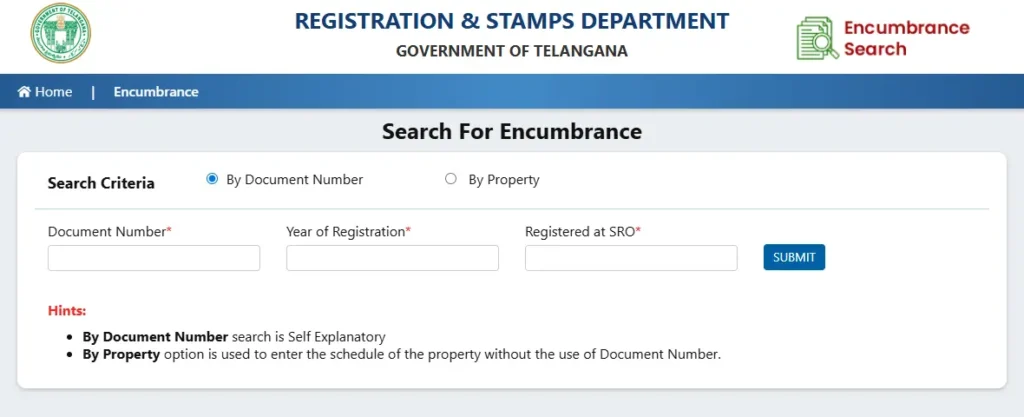
- Search Criteria: Navigate to “Encumbrance Search.” You can search via:
- Document Number: You must enter the Document ID, the Registration Year, and select the correct SRO Code from the dropdown menu (this is where most users fail).
- Property Details: Input the District, Mandal, and Village, followed by the Survey Number or Plot Number.
- House Number: Search using the specific door number and locality.
- Download: Once the results appear, select the required years and download the PDF.
2. Using the Bhu Bharathi Portal (bhubharati.telangana.gov.in)
For agricultural lands registered after 2020, Bhu Bharathi is the “Single Point of Truth.”
- The primary key for searching on Bhu Bharathi is the Pattadar Passbook Number.
- Because land classifications often shift from agricultural to urban (e.g., Gachibowli or Nanakramguda were historically agricultural), I recommend checking both portals for a comprehensive history.
Understanding the Fees and Processing Timelines
The government fee structure is definitively calculated based on both the search period and the applicant’s profile.
| Fee Component | Amount |
| Service Charge | ₹25 |
| Legal Fee (Search up to 30 years / Applicant < 30) | ₹200 |
| Legal Fee (Search over 30 years / Applicant ≥ 30) | ₹500 |
Processing Timelines:
- Standard Online Search: 1–3 working days (up to 6 days during peak hours).
- Complex/Manual Records: Up to 30 days if the search involves un-digitized records or requires SRO intervention.
How to Read Your Telangana EC Like a Pro
A professional consultant looks beyond the names. Here are the five columns you must verify:
- Property Description: Verify the Boundaries (North, South, East, West). This is the most critical area; cross-verify these against the physical land to ensure no “encroachment” or “shifting” of plot lines has occurred over time.
- Dates of Registration/Execution: The Execution Date is when the deed was signed, while the Registration Date is when it entered the government database.
- Nature of Deed: Identifies if the act was a Sale, Gift, Release, or Mortgage.
- Names of Parties: Look for EX (Executant)—the Seller or Giver—and CL (Claimant)—the Buyer or Receiver.
- Document Number/Year: The unique ID for the specific transaction.
Resolving Common EC Issues
- “No Records Found”: Verify your Survey Number against the original Sale Deed. If the portal still shows no records, a manual search at the SRO is required (Fee: ₹500).
- Pending Status: If your application status remains “Pending” for more than 5 working days, call the Helpline Number (040-23041100) or visit the SRO with your acknowledgment slip.
- Clerical Errors: If the EC shows a typo in the name or boundaries, you must file a Rectification Deed at the SRO to correct the original registered record.
Frequently Asked Questions (FAQs)
Can NRIs apply for a Telangana EC?
Yes. NRIs can access the IGRS portal from any location. You only need the property details and a valid ID for registration.
How long is the EC valid?
For most banking and legal purposes, an EC is considered “current” for 6 months from the date of issuance.
Does the EC show ongoing court cases?
Digital records may show “Court Attachment Orders,” but they often do not reflect ongoing litigation that hasn’t reached an attachment stage. I always recommend a separate judicial search for high-value transactions.
Is the EC mandatory for property registration?
Absolutely. The IGRS requires a current EC to confirm the absence of prior liens before they will allow a new registration to proceed.
How do I get an ink-signed copy?
While digital ECs are legally valid, some specific legal or international requirements may necessitate an ink-signed copy. These must be obtained physically from a MeeSeva center or the Sub-Registrar Office.
Conclusion
Securing an Encumbrance Certificate is the first and most vital step toward a secure property transaction in Telangana. In an era of rapid appreciation and sophisticated title fraud, proactive title management is your greatest asset.