Introduction to Encumbrance Certificate (EC) in Telangana
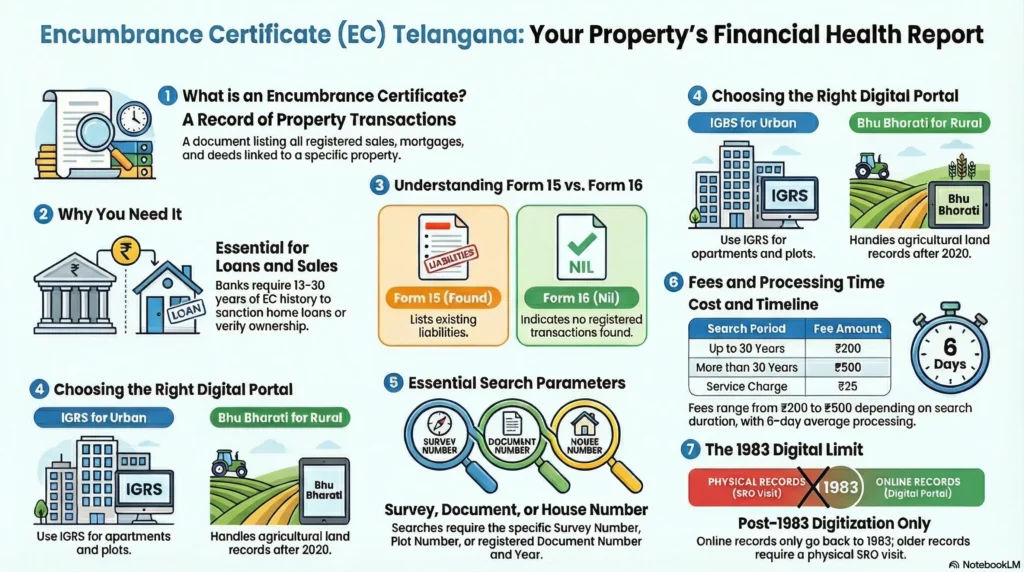
In the complex world of real estate, an Encumbrance Certificate Telangana is the most critical piece of evidence regarding a property’s legal standing. An EC is a formal legal document that records all registered transactions associated with a specific property over a defined period. Its primary purpose is to provide a “clear and marketable title” verification, revealing whether the asset is burdened by financial or legal claims such as mortgages, outstanding loans, liens, or court-ordered attachments. For any serious investor or homeowner in Telangana, understanding the EC is the first step in mitigating the risks of a fraudulent or disputed transaction.
Why You Need an EC for Property Transactions
As a legal expert, I advise that an EC is not merely a formality but a shield for all parties involved:
- Buyers: Use it to verify the seller’s genuineness and ensure the property isn’t collateral for an undisclosed loan. It is the primary tool for verifying the “Chain of Title.”
- Sellers: It serves as definitive proof of ownership and a “clean” liability status, which is essential for closing high-value deals.
- Lenders/Banks: No financial institution in India will sanction a home loan without an EC. Banks typically require a transaction history of 10 to 15 years to ensure the security of their collateral.
The EC records specific legal deeds, including:
- Sale Deeds & Gift Deeds
- Partition and Settlement Deeds
- Mortgage Deeds (and Discharge Receipts)
- Lease Deeds (Long-term)
- Release Deeds (used to release claims in successions or mortgages)
- Court Attachment Orders
Understanding the Ecosystem: IGRS Telangana vs. Bhu Bharathi
Property governance in Telangana is split between two primary portals. Understanding which one to use is vital, especially for areas like Gachibowli, Madhapur, and Nanakramguda, which have recently transitioned from agricultural to urban hubs.
| Feature | IGRS (Registration & Stamps Dept) | Dharani / Bhu Bharathi (Revenue Dept) |
| Primary Focus | Urban properties and all historic registrations. | Agricultural land registrations. |
| Cutoff Date | Records before 2020 and all urban deeds. | Agricultural transactions after 2020. |
| Digitization | Records available from 01/01/1983. | Modern agricultural records only. |
| What to Search | Navigate to “Encumbrance Search.” | Navigate to “Land Details Search.” |
Expert Advice: If you are dealing with a property in a developing urban corridor, check both portals. A property currently classified as urban may have a legacy recorded in the Bhu Bharathi (Revenue) system from its time as agricultural land.
Types of Encumbrance Certificates in Telangana
The Registration Department issues results in two distinct forms:
- Form 15: Issued if the property has recorded encumbrances (sales, mortgages, etc.). It provides a serial list of all registered transactions.
- Form 16 (Nil EC): Issued when no transactions are found for the requested period. While this often indicates a “clear” record, it must be treated with caution (see Section 10 on “False Negatives”).
Furthermore, distinguish between a Regular EC (general history) and a Mutation EC, which specifically reflects changes in ownership due to inheritance or sale.
Step-by-Step: How to Apply and Search for EC Online
Preparation
Ensure you have the following data points:
- District, Mandal, and Village names.
- Survey Number and Plot Number.
- Document Number and Registration Year (if available).
- SRO (Sub-Registrar Office) jurisdiction.
Process via IGRS Portal
- Access: Visit the official IGRS Telangana portal (registration.telangana.gov.in).
- Login: Register or sign in using a mobile number and email.
- Search: Click on ‘Encumbrance Search’ under Online Services.
- Disclaimer: Read and ‘Submit’ the disclaimer regarding digitized records.
Search Methods
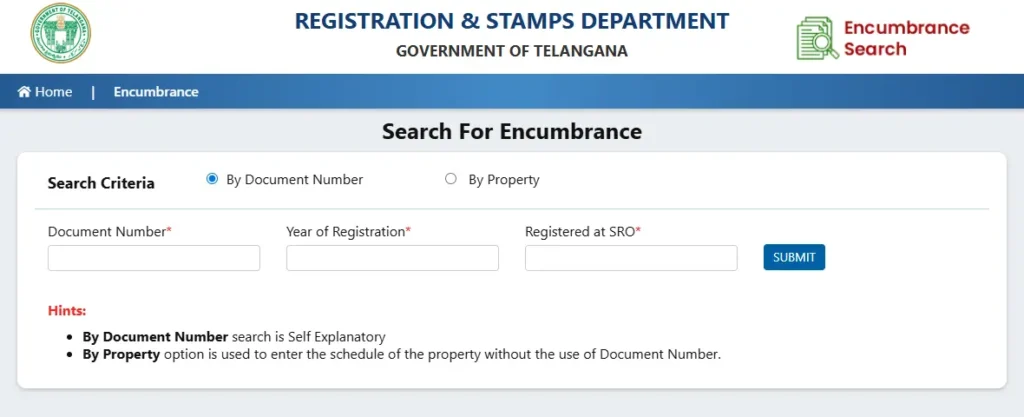
- By Document Number: Enter the SRO, Registration Year, and specific Document Number.
- By Property Details: If you lack the document number, enter the District, Mandal, and Village, followed by the Survey or Plot/House number.
Alternative Application: MeeSeva and Offline Methods
- MeeSeva Portal: Citizens can apply through MeeSeva by downloading the form and submitting it at a physical center. The status is communicated via SMS.
- Offline (Sub-Registrar Office): Digitized records only go back to 1983. If you require a search for the “inception” of a property’s history (pre-1983), you must visit the local SRO and submit Form 22 for a manual search of physical registers.
Fee Structure and Processing Timelines
In Telangana, the legal fees for an EC are unique because they are determined by the applicant’s age, in addition to standard service charges.
| Service Item | Fee Amount |
| Application/Service Fee | ₹25 |
| Applicants below 30 years | ₹200 |
| Applicants aged 30 and above | ₹500 |
Note: For searches exceeding 30 years, SRO approval is typically required, and additional fees may apply.
Timelines:
- Online Viewing/Status: 1–3 working days.
- Certified/Digitally Signed Copies: 6+ working days.
- Complex/Manual Records: Can take up to 30 days.
How to Track Application Status and Download the EC
- Log in to the IGRS portal and select ‘Application Status.’
- Enter the application number generated during submission.
- Once the status is ‘Completed,’ a download link for the PDF will appear.
- Verification: Always ensure the downloaded PDF contains the digital signature. For court or bank use, some may require a notary-attested copy or an ink-signed copy from the SRO.
Detailed Breakdown: How to Read a Telangana EC
Decoding an EC requires an understanding of shorthand legal codes used by the department:
- Link Document Number: This is the most vital part of the EC. It provides the document number of the previous transaction, acting as a “bridge” to verify the uninterrupted Chain of Title.
- Name of Parties:
- EX (Executant): The person giving/selling the property.
- CL (Claimant): The person receiving/buying the property.
- Nature of Deed Codes:
- (MR): Mortgagee (The lender/bank).
- (ME): Mortgagor (The borrower).
- (LR): Lessor (The landlord).
- (LE): Lessee (The tenant).
- Market Value vs. Consideration Value: Market value is the government’s base price for stamp duty; Consideration value is the actual price paid between parties.
Troubleshooting Common Errors and “Nil EC” Scenarios
- The “False Negative” Warning: A Nil EC (Form 16) does not always mean the property is clear. It may be a “False Negative” caused by entering a Plot Number that doesn’t exist in that specific village or small clerical errors in the search parameters.
- Rectification: If you find a clerical error (e.g., misspelled name) on an issued EC, you must file a ‘Rectification Deed’ at the SRO. Note: Substantive errors (wrong owner or area) require legal intervention beyond a simple rectification.
- Payment Failures: If your UPI/Net Banking fails, wait 24 hours. If issues persist, contact the Helpline: 040-23041100.
What is NOT Included in an EC?
Buyers must understand that an EC is only a record of registered transactions. It does not include:
- Ongoing Litigation: Court cases that haven’t reached a final attachment order.
- Unregistered Documents: Wills (testamentary), oral agreements, and short-term leases (under 11 months).
- Tax Dues: Outstanding property tax or municipal dues.
- Prohibited Lands: Specific land-use restrictions (though some newer agricultural ECs are beginning to show these markers).
Frequently Asked Questions (FAQs)
Is EC mandatory for registration?
Yes, the IGRS requires it to prove the title is clear before any new deed is registered.
How long is it valid?
Generally, banks and legal bodies accept an EC for 6 months from the date of issue.
Can NRIs apply?
Yes, the IGRS and MeeSeva portals allow online applications from anywhere in the world.
Why only 1983?
This is the state’s digitization cutoff. For earlier history, manual intervention at the SRO is the only path.
Conclusion and Final Expert Advice
The Encumbrance Certificate is the essential “entry point” for property due diligence in Telangana, but it is not the finish line. To ensure a truly secure investment, I recommend a three-pronged approach:
- Check the EC for the longest possible period (at least 30 years).
- Verify the Chain of Title using the “Link Document” numbers found in the EC.
- Conduct Secondary Checks: Verify the Pattadar Passbook for agricultural land, check judicial records for pending litigation, and physically verify possession and original title deeds.
For further assistance or to resolve persistent issues, always contact the official helpline at 040-23041100.