India’s digital revolution has already redefined finance and healthcare, turning the nation into a global leader in citizen-centric Digital Public Infrastructure (DPI). Now, this transformation is coming to the field. With the Union Cabinet’s approval of the Digital Agriculture Mission—backed by a Rs. 2,817 Crore total outlay (including a Central Government share of Rs. 1,940 Crore)—the government is laying the “digital rails” for a modern agricultural economy. At its core is AgriStack, a framework designed to unify a highly fragmented sector. As a strategist, I see this as the “Agri-tech leap” necessary to move from isolated innovations to a truly integrated ecosystem. By leveraging the 80% rural internet penetration achieved over the last four years, this mission aims to provide a trusted digital identity to millions, ensuring India’s journey toward a “Viksit Bharat” by 2047 is rooted in technology-driven food security.
What is AgriStack? Understanding ‘Kisan ki Pehchaan’
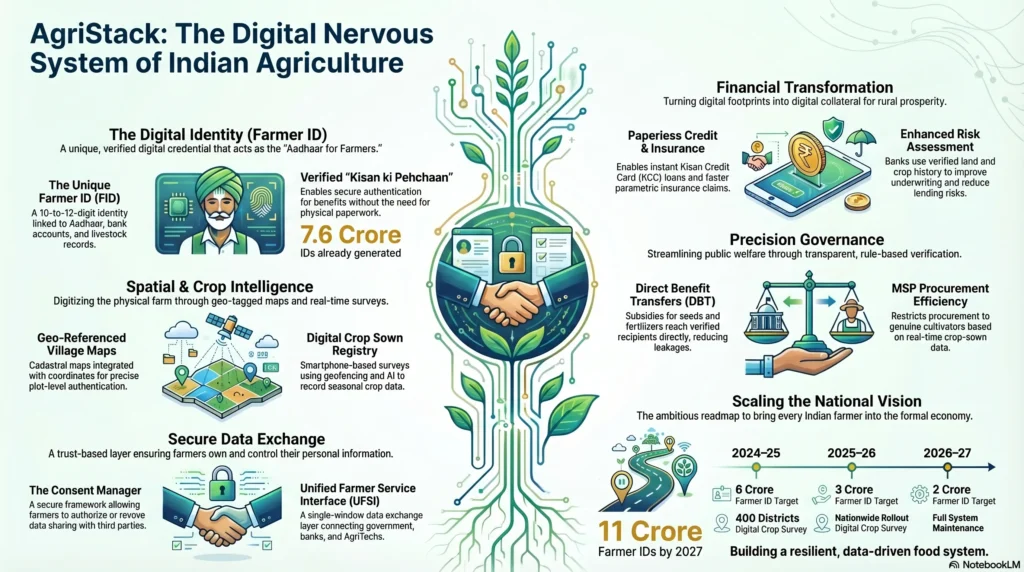
AgriStack is the cornerstone of India’s new Digital Agriculture Mission. It is a farmer-centric Digital Public Infrastructure (DPI)—a set of shared digital blocks that allow different systems to work together. Think of it as the “Aadhaar card for farmers.” Just as Aadhaar provided a unique identity for every citizen, the Farmer ID within AgriStack creates a “Kisan ki Pehchaan,” a trusted digital identity that proves who a farmer is and what they do.
This identity is powerful because it is interoperable (meaning different government and private computer systems can easily talk to each other and share data). Created and maintained by State Governments and Union Territories, this ID links together:
- Land records: Verified proof of land holdings.
- Livestock ownership: Digital records of a farmer’s animals.
- Crops sown: Ground-truth data of what is currently in the field.
- Benefits availed: A transparent log of subsidies, insurance, and loans.
By creating this “digital glue,” AgriStack solves the problem of data fragmentation, allowing the government to deliver services with pinpoint accuracy.
The Three Pillars of the AgriStack Architecture
To move from outdated paper-based systems to a future-ready sector, AgriStack is built on three architectural pillars:
- Farmers’ Registry: The foundational database containing the digital identities of farmers, linked to their demographics and assets.
- Geo-referenced Village Maps: This connects land parcels to specific geographic coordinates. It ensures that every Farmer ID is anchored to a verifiable location on a map, reducing disputes and enabling precision services.
- Crop Sown Registry: A real-time record of agricultural activity updated through the Digital Crop Survey.
The government is moving aggressively on this front, with targets to launch the Digital Crop Survey nationwide within two years. The goal is to cover 400 districts in FY 2024-25 and reach every district by FY 2025-26.
Why It Matters: Key Benefits for the Indian Farmer
For the average smallholder, AgriStack represents a shift from “Innovation” (new tools) to “Integration” (joined-up services). The mission addresses the “fragmented user base” issue by providing a single point of entry for several life-changing benefits:
- Digital Authentication: Farmers can access schemes via digital verification, eliminating the need for multiple physical visits and mountains of paperwork.
- Financial Inclusion: Verified data on land and crops allows banks to approve crop loans and insurance claims faster and with more transparency.
- Precise Yield Estimation: Through the Digital General Crop Estimation Survey (DGCES), the mission uses technology to provide accurate yield data, ensuring fairer insurance payouts.
- Real-Time Advisories: Farmers receive personalized advice for irrigation and pest management based on the specific data in their profile.
- Employment Potential: The mission is a massive job engine, expected to create opportunities for 2,50,000 trained local youth and ‘Krishi Sakhis’ to manage the digital registries and surveys.
Implementation: From Pilot Projects to National Scale
The transition to a digital-first agriculture sector is already underway. So far, 19 states have signed Memorandums of Understanding (MoUs) with the Ministry of Agriculture. To ensure the “digital rails” were sturdy, the government conducted intensive pilot projects in six states and specific districts:
- Uttar Pradesh: Farrukhabad
- Gujarat: Gandhinagar
- Maharashtra: Beed
- Haryana: Yamuna Nagar
- Punjab: Fatehgarh Sahib
- Tamil Nadu: Virudhnagar
The road ahead is clearly defined by a 3-year phased target to reach 11 crore farmers:
- Year One (FY 2024-25): 6 crore farmers
- Year Two: 3 crore farmers
- Year Three: 2 crore farmers
🌾 AgriStack Farmer Registry Portals – State-wise
🌐 National Portal:
Main Portal: https://agristack.gov.in 👉 This is the central platform for Digital Agriculture and farmer data integration.
🧭 Major State Portals (Official Pattern: statecode + fr.agristack.gov.in)
| State | Farmer Registry Portal |
|---|---|
| Andhra Pradesh | https://apfr.agristack.gov.in |
| Telangana | https://tgfr.agristack.gov.in |
| Tamil Nadu | https://tnfr.agristack.gov.in |
| Karnataka | (in progress / state-specific system) |
| Kerala | https://klfr.agristack.gov.in |
| Maharashtra | https://mhfr.agristack.gov.in |
| Gujarat | https://gjfr.agristack.gov.in |
| Rajasthan | https://rjfr.agristack.gov.in |
| Madhya Pradesh | https://mpfr.agristack.gov.in |
| Uttar Pradesh | https://upfr.agristack.gov.in |
| Bihar | https://bhfr.agristack.gov.in |
| Jharkhand | https://jhfr.agristack.gov.in |
| Odisha | https://odfr.agristack.gov.in |
| Chhattisgarh | https://cgfr.agristack.gov.in |
| Haryana | https://hrfr.agristack.gov.in |
| Punjab | (state agri portal integration) |
| Assam | https://asfr.agristack.gov.in |
| Himachal Pradesh | https://hpfr.agristack.gov.in |
| Uttarakhand | https://ukfr.agristack.gov.in |
Supporting Systems: Krishi DSS and Soil Mapping
AgriStack does not work in a vacuum. It is supported by high-tech systems that turn raw data into actionable intelligence:
Krishi Decision Support System (DSS): This is a geospatial (mapping and analyzing data linked to specific locations) system that integrates remote sensing with weather and water data. By using AI-powered analytics and satellite-powered crop management, the Krishi DSS is designed to help farmers achieve a 15%–20% yield increase through better resource planning.
Soil Profile Mapping: Soil health is vital for sustainability. The mission aims to map 142 million hectares at a high-detail 1:10,000 scale. India has already made significant progress here, having issued 25 crore Digital Soil Health Cards. This data integrates with AgriStack to provide precise, AI-driven fertilizer recommendations, reducing costs and environmental impact.
AgriStack vs. Private Platforms: A New Paradigm
India’s agri-tech landscape is at a turning point. Currently, innovation is “abundant” but adoption is “uneven” because many private platforms like DeHaat or Ninjacart operate in silos, catering to specific market-driven clusters.
AgriStack changes this by moving from “Innovation” to “Integration.” While private players innovate with supply chain apps, AgriStack provides the public infrastructure—the “digital rails”—that these players can build upon. It solves the “fragmented user base” problem by creating a national, interoperable standard. This allows a smallholder in a remote district to access the same high-tier private innovations as a large-scale farmer, simply by using their verified Farmer ID.
Competitor Comparison Table: DPI vs. Private Innovation
| Feature | AgriStack (Public DPI) | Private Platforms (e.g., DeHaat/Ninjacart) |
| Core Function | Identity & Foundational Data Layer | Supply Chain & Marketplace Services |
| Primary Identity | Government-verified ‘Farmer ID’ | App-based User Registration |
| Data Scope | Land records, Soil, & National Registry | Transactional, Input & Output data |
| Inclusivity | National mandate (11 Crore farmers) | Market-driven (Specific clusters) |
| Goal | Efficient service/scheme delivery | Productivity & Profitability optimization |
| Scaling Mechanism | State-level “Agri-tech sandboxes” | Localized product-market fit |
The Road to ‘Viksit Bharat’: Conclusion
The Digital Agriculture Mission is the strategic umbrella that will drive India’s $1 trillion agriculture vision. While the Rs. 2,817 Crore outlay for this mission is a vital start, it is part of a massive Rs 14,235.30 crore commitment across six major schemes. These include significant investments in Crop Science (Rs 3,979 crore) and Sustainable Livestock Health (Rs 1,702 crore), all aimed at ensuring food security and climate resilience by 2047.
By integrating AI, geospatial data, and a unified Farmer ID, India is ensuring that its most critical sector is no longer fragmented. AgriStack is more than just a database; it is the foundation for an environmentally sustainable, tech-driven, and future-ready agriculture sector that will transform the lives of millions.