Welcome to the definitive guide for property registration in Telangana. As the state transitions into a fully digitized land administration era, navigating the legalities of property ownership has become both more transparent and more technically demanding. The implementation of the Telangana Bhu Bharati Act, 2025 (Act No. 1 of 2025) marks a revolutionary shift from the Dharani portal to a more robust, satellite-integrated system.
For buyers in 2026, understanding the Stamp Duty Telangana 2026 rates—currently totaling a 6% levy for urban sales—is the first step in financial planning. This guide, drafted from the perspective of a legal expert and SEO strategist, will provide the statutory clarity and practical steps you need to secure your property rights under the new “Record of Rights” (RoR) framework.
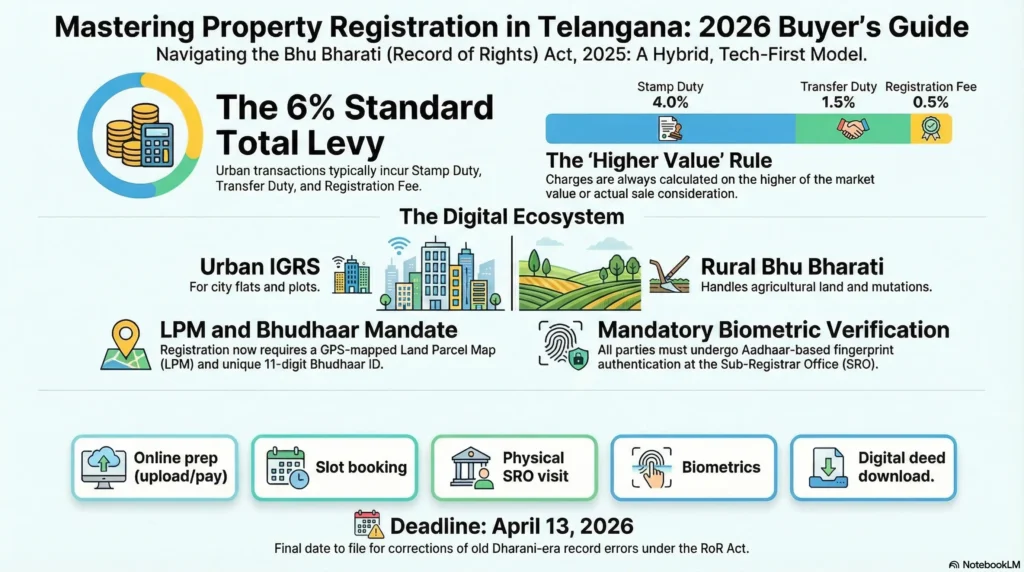
Breaking Down the Costs: Stamp Duty, Registration, and Transfer Duty
In Telangana, “Registration Charges” are a composite of three distinct statutory levies. When calculating your Stamp Duty Telangana 2026 obligations, you must account for the following breakdown:
- Stamp Duty (4%): A mandatory state tax on the transaction instrument as per the Indian Stamp Act, 1899.
- Transfer Duty (1.5%): A duty applicable to properties within urban local bodies like the GHMC or other Municipalities.
- Registration Fee (0.5%): A fee for the official recording of the deed. Statutory Note: For sale deeds, this fee is typically subject to a minimum of ₹5,000 and a maximum cap of ₹20,000.
How Calculations Work
Charges are calculated on the higher of the Actual Sale Consideration or the Government Market Value (Guidance Value).
Expert Calculation Example: If you are purchasing a premium apartment in Hyderabad with a Market Value of ₹1 Crore:
- Stamp Duty (4%): ₹4,00,000
- Transfer Duty (1.5%): ₹1,50,000
- Registration Fee (0.5%): Calculated as ₹50,000, but capped at ₹20,000.
- Total Payable Charges: ₹5,70,000
Current Rates Table for 2025-2026
The following table synthesizes the current rates for various instruments under the Bhu Bharati Act 2025.
| Transaction Type | Stamp Duty | Transfer Duty | Registration Fee | Total |
| Sale Deed (Urban) | 4% | 1.5% | 0.5% (Capped) | 6% |
| Sale Deed (Rural) | 4% | 1.5% | 0.5% (Capped) | 6% |
| Gift Deed (Family) | 0.5% | Nil | 0.5% (Max ₹20k) | 1% |
| Gift Deed (Non-Family) | 4% | Nil | 0.5% (Max ₹20k) | 4.5% |
| Mortgage (with possession) | 5% | Nil | Fixed ₹2,000 | 5% + Fee |
The Bhu Bharati Revolution: What’s New in 2026?
The Bhu Bharati Act 2025 (Act No. 1 of 2025) has consolidated land laws to bring the Revenue, Survey, and Registration departments under one digital umbrella: the Bhu Bharati Portal.
Meet Your ‘Bhudhaar’ Number
Under Section 9 of the Act, every land parcel is assigned a unique Bhudhaar identification number.
- Temporary Bhudhaar: Assigned when geo-referencing is pending.
- Permanent Bhudhaar: Assigned after completion of geo-referencing, linking the land to its exact coordinates.
- Pro Tip: Per Section 9(1), land belonging to the Government, Local Bodies, or Community is assigned Bhudhaar numbers from a specially reserved series to prevent encroachment and illegal registration.
The Pilot Rollout and Mandatory LPM
As of April 2, the system is live in five pilot mandals: Kosgi, Amangal, Vatpally, Kusumanchi, and Aswaraopeta. In these zones, the LPM (Land Parcel Map) is now a Statutory Requirement for registration. Unlike old hand-drawn sketches, the LPM is satellite-based and shows:
- Precise geo-coordinates of all corner points.
- Exact shapes of the land parcel.
- Measured road widths to eliminate future encroachment disputes.
Step-by-Step Guide to Registering Your Property
The 2026 registration process is a hybrid model designed for Mandatory Compliance.
- Market Value Verification: Check the IGRS/Bhu Bharati portal for the latest guidance value to ensure your Stamp Duty Telangana 2026 calculation is accurate.
- E-Stamping: Purchase digital stamps via SBI ePay. This secure system (Section 5) eliminates physical stamp paper fraud.
- Slot Booking: Use the RoR Portal to book one of the 48 daily slots available per SRO. Slots must be booked at least 24 hours in advance.
- Physical Visit & E-KYC: All parties (buyer, seller, and two witnesses) must attend the SRO. Under Section 2(4), biometric verification against Aadhaar is mandatory to prevent impersonation.
- Digital Record Updates: Upon successful registration, the Registrar updates the electronic Record of Rights instantly for agricultural land.
Legal Alert: Before your appointment, monitor local news for “Server Glitches.” Disruptions reported in March 2026 occasionally affect challan payments and slot bookings. Always carry a digital copy of your payment receipt.
Essential Documentation Checklist
- Primary: Original Sale Deed (drafted as per Act 1 of 2025), E-Stamp Certificate.
- Identity: Aadhaar Card (Linked to mobile for OTP/E-KYC) and PAN Card.
- Technical: LPM (Land Parcel Map) with satellite coordinates (Mandatory in pilot zones).
- Historical: Encumbrance Certificate (EC) for 30 years and recent Property Tax receipts.
Competitor Analysis & Comparison
Telangana’s Bhu Bharati system is now the national benchmark for digital land administration, moving far beyond the fragmented systems of the past.
Telangana Bhu Bharati vs. Traditional Systems
| Feature | Telangana (Bhu Bharati) | Traditional Systems |
| Verification | Aadhaar-linked E-KYC | Manual ID card check |
| Parcel ID | Bhudhaar (Permanent/Temporary) | Survey Number only |
| Mapping | Satellite-based LPM | Hand-drawn sketches |
| Passbook Rule | Digital RoR Primary (Sec 10) | Physical Passbook mandatory |
Post-Registration: The Mutation Process
Under Section 5 of the Bhu Bharati Act, the distinction between agricultural and urban mutation is critical:
- Agricultural Land: Under Section 5(5), mutation is automatic. The Tahsildar must amend the Record of Rights immediately after registration.
- Urban/Non-Agricultural Land: Under Section 5(9), mutation is not automatic through the SRO. Owners must follow the Municipal/Panchayat Raj Acts (GHMC/Local Bodies) to update tax records.
Passbook Note (Section 10(8)): Registering authorities and credit agencies are now legally prohibited from insisting on a physical Pattadar Passbook if the electronic record is available in the RoR portal.
Frequently Asked Questions (FAQs)
What is a Small/Marginal Farmer under the 2025 Act?
Per Section 2(26), a “Small or Marginal Farmer” holds less than 2.5 acres of wet land or 5 acres of dry land. The law applies a 1:2 ratio (1 acre of wet land = 2 acres of dry land).
Can banks refuse a loan without a physical passbook?
No. Under Section 10(6), credit agencies must use the electronically maintained Record of Rights for granting loans and cannot insist on physical documents if the digital record is verified.
What if my E-KYC fails at the SRO?
E-KYC is a statutory requirement. If biometrics fail, you must update your Aadhaar data at a CIDR center and re-book your registration slot. Registration cannot proceed without successful Aadhaar authentication.