The Telangana real estate market reached a historic turning point on April 1, 2025. For the first time in nearly a decade, the state government implemented a comprehensive, “scientifically determined” revision of property values. This wasn’t merely a tax adjustment; it was an empirical correction designed to align the official IGRS Telangana Market Value with actual ground realities, effectively curbing under-the-table transactions and creating a more transparent digital footprint for every property.
As we navigate 2026, understanding these benchmarks is no longer optional—it is the foundation of financial due diligence. Whether you are targeting a luxury high-rise in the Financial District or a plot in emerging Budvel, this guide provides the strategic clarity needed to master the IGRS portal and protect your investment capital.
Understanding the 2025-2026 Market Value Revision
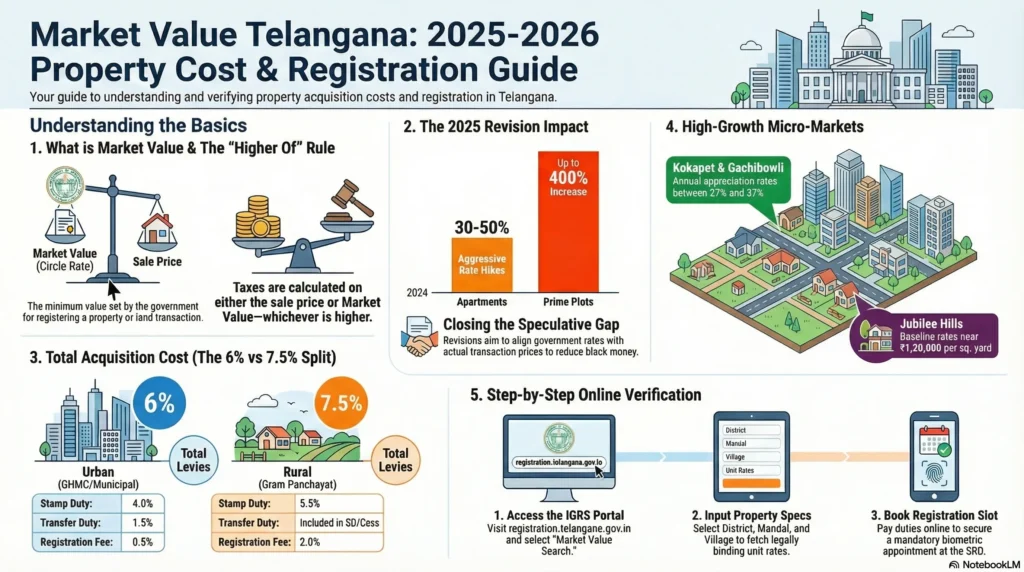
The “Market Value” (also known as the Guidance Value or Circle Rate) is the legally mandated price floor set by the Inspector General of Registration and Stamps (IGRS). The 2025 revision ended a long-standing valuation gap, using data-driven modeling to ensure government rates reflect the booming demand in the IT corridors.
Key Outcomes of the Scientific Revision:
- The Apartment Surge: Residential units across the state saw an average hike of 30% to 50%.
- Prime Zone Spikes: Global interest in the West Zone led to corrections of 100% to 400% in specific pockets of Kokapet, Gachibowli, Kondapur, and Budvel.
- Revenue & Transparency: The revision is projected to yield a 40% increase in state revenue while mandating that no property can be registered below these scientific benchmarks.
- Valuation Methodology: While IGRS sets the floor, savvy investors now use the Rental Yield Method to determine true value. In Hyderabad, yields currently average 4.2%, outperforming several other Indian metros.
Step-by-Step: Checking 2026 Rates on the IGRS Portal
Banks and financial institutions now strictly require the Market Value Certificate (MVC) generated from this portal for technical verification and loan approvals. Follow this precise process to avoid data errors:
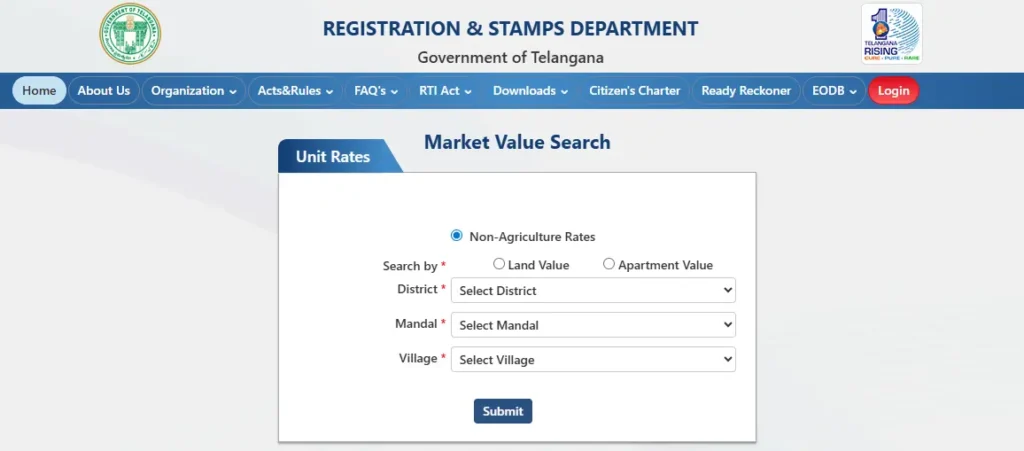
- Access the Portal: Visit the official government gateway at registration.telangana.gov.in.
- Market Value Search: Under the ‘Online Services’ section, select “Market Value Search.”
- Define Property Type: Choose between “Land Value” (for plots/vacant land) or “Apartment Value” (for flats/units).
- Input Precise Location:
- For Land: Select District > Mandal > Village. You must then type the specific Locality or Society Name in the search field to get micro-market rates.
- For Apartments: Select District > Mandal, then find your specific building in the dynamic project name list. If your project is not listed, it may still be categorized under general “Unit Rates” for that village.
- Interpret the Benchmark: Click ‘Submit’ to see the current circle rate per square yard (land) or square meter (apartments).
Strategist’s Pro-Tip: Always compare the IGRS value against the market asking price. If the gap is less than 10%, the property is likely priced at fair market value. If the market price is significantly higher than the IGRS rate, use the 4.2% rental yield benchmark to verify if the premium is justified.
Navigating Telangana’s Digital Realty Maze
While the IGRS portal provides the legal floor, these platforms offer the “market pulse.” However, as a strategist, I advise caution regarding their specific limitations:
- Magicbricks: The “Veteran Powerhouse.” It is indispensable for high-level research and price trends across Tier-I and Tier-II cities like Karimnagar and Warangal. Limitation: Information overload can lead to encountering unverified listings.
- 99acres: The “New Launch Specialist.” Excellent for monitoring inventory growth in the commercial sector (which grew 65% since 2020). Limitation: Often suffers from overlapping listings and pricing inconsistencies between brokers.
- Housing.com: The “Visual Pioneer.” Its use of 3D tours and “Locality Scores” is perfect for NRI buyers. Limitation: The database can be thinner in peripheral rural zones compared to urban centers.
Platform Comparison: 2026 Real Estate Ecosystem
| Platform | Best For | Key Strength | Notable Limitation |
| Magicbricks | Broad Research | Vast database & Price Trend tools | Significant volume of unverified listings |
| 99acres | Commercial/New Projects | 65% growth in commercial inventory | Pricing inconsistencies & duplicate listings |
| Housing.com | Visual Discovery | High-quality 3D tours & visuals | Inconsistent depth in suburban localities |
| NoBroker | Cost Efficiency | Direct owner-to-buyer connections | No professional legal or negotiation support |
| Square Yards | New Launches | Direct access to pre-launch projects | Heavy focus on developer-aligned promotions |
| Roof Enclaves | Luxury Investors | Specialized advisory & ROI analysis | Smaller, niche portfolio for high-end buyers |
| Nayeghar | Transparency | Verified listings & user-centric design | Emerging brand; lower awareness in rural zones |
Hyper-Local Spotlight: Hyderabad’s 2026 Growth Corridors
The MarketBeat data for 2026 reveals specific “hot zones” where capital growth is outpacing the city average:
- Residential Dominance: The West Zone (Financial District and Nanakramguda) remains the powerhouse, capturing 65% of all new residential launches.
- The Outperformer: While citywide capital values rose 3% Y-o-Y, the Narsingi-Kokapet cluster saw a staggering 12% capital growth and 10% rental growth.
- North Zone Rise: Balanagar has emerged as a key contributor to the North Zone’s 19% share of new launches, driven by industrial-to-residential conversions.
- Office Demand: IT BPM leads the charge at 44% of total office demand, followed by BFSI at 35%.
Strategic Actions for 2026 Stakeholders
For Buyers:
- Buffer Your Budget: Factor in the higher stamp duty immediately. Because the 2025 revision was so steep (up to 400% in places like Budvel), your “upfront” registration costs may be 5-8% higher than 2024 estimates.
- Verify “EV-Readiness”: With the 2026 trend toward sustainable homes, prioritize properties with EV charging. These are seeing faster appreciation in the West Zone.
For Sellers:
- The Price Floor: Use the revised IGRS rate as your absolute floor. The “scientific determination” of these rates provides a legal justification for your asking price during negotiations.
- Capital Gains Planning: Ensure your sale price is well above the IGRS value. Registering a property at a “discount” near the circle rate can trigger aggressive capital gains tax scrutiny from the IT department.
Conclusion: Mastering the Market
The 2026 Telangana property market is defined by two words: Digital Transparency. By utilizing the IGRS portal for legal benchmarks and premium platforms like Roof Enclaves or Nayeghar for strategic discovery, you eliminate the guesswork that plagued the last decade.
For those looking beyond urban limits, the Bhu Bharathi portal remains the authority for agricultural and farmland transactions. It is essential for assessing long-term value appreciation in the state’s burgeoning rural corridors.
FAQ Section
What is the difference between market price and IGRS circle rate?
The market price is the actual price agreed upon between buyer and seller. The circle rate (Market Value) is the government’s minimum mandated price for a locality. By law, you must pay stamp duty on whichever value is higher.
Can I register a property below the IGRS value?
No, this is illegal. Attempting to register below the guidance value will result in the registration being blocked and can lead to severe penalties, legal scrutiny, and major complications regarding capital gains tax assessments in the future.
When was the last major rate revision in Telangana?
The last comprehensive, scientifically-backed revision of land and property rates came into effect on April 1, 2025, and remains the active benchmark for all transactions in 2026.